Introduction
Facial reflex therapy and essential oil–based skincare are commonly used in complementary practice to support skin health and emotional well-being. However, limited studies explore their combined effect in a menopausal context.
This case study examined how a personalised, integrative facial care approach might affect a client’s emotional and physical well-being. Combining facial reflex therapy and aromatherapeutic skincare, it explored their joint effects in a structured, one-to-one setting
Research on using these therapies together in menopausal clients is limited. This case study aimed to assess whether the combined approach could support both skin changes and emotional balance. Furthermore, it explores the potential benefits of integrating facial reflex therapy Sorensensistem™ with an aromatherapeutic facial oil on skin texture, facial muscle tone, and emotional well-being in menopausal clients.
Menopause often causes visible skin changes alongside emotional shifts and loss of internal balance. These issues are interconnected with stress impacting skin health and appearance, influencing mood and self-perception. The treatment plan reflected this complexity. Rather than targeting a single symptom, the approach treated the face as a map of the whole person, encompassing their emotional, energetic, and physical aspects. Sessions combined skilled touch with therapeutic scent to support skin texture, ease tension, and foster inner balance and self-connection.
The case follows one client through ten sessions, using reflective feedback, visual records, and practitioner notes to track changes in appearance and deeper emotional well-being. Written informed consent for the use of anonymised data and publication of photographs was obtained from the client prior to the study.
Case description
The client, age 56, presented with menopausal symptoms, including fatigue, heightened anxiety, and panic attacks, and peri-oral skin irritation. She also reported persistent jaw tightness, poor sleep quality with fear and worry, and difficulty regulating stress while acting as the full-time caregiver for her elderly mother.
Although she had not previously experienced facial reflex therapy, she was familiar with facials and used Aromatherapy informally at home. Her initial focus was on improving her skin tone and texture, though she was open to supporting emotional well-being if it emerged as part of the process.
Medications included prescribed hormone replacement therapy (HRT) (Estradot and Utrogestan) and antihypertensive medication (Losartan). She had a history of topical steroid use (Betnovate steroid cream and Betacap steroid scalp solution) for dermatitis. No known allergies were declared.
Facial reflex therapy treatment plan
The sessions were structured progressively, guided by the client’s feedback and the evolving presentation of their skin.
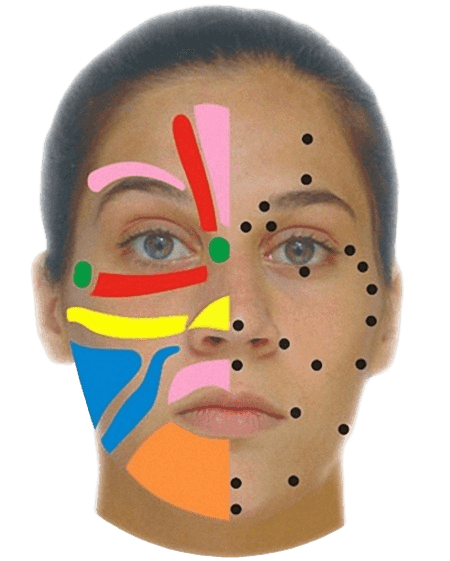
The facial microsystem reflex map uses specific points and areas on the face that correspond to internal organs and systems. In the basic seven-step sequence (Cassara and Carrasco, 2013; Sorensen, 2011b), these points and areas are gently stimulated to support systemic balance, muscle release, and relaxation of both body and mind.
In session one, the area with the largest deposit on the face (swollen tissues indicating bodily imbalances) was identified and analysed. From session two onwards, additional techniques were introduced to expand the therapeutic effect. These included:
- NP and N points: nerve points that support the body’s central nervous system (Sorensen, 2011a, 2011b).
- Colon link: used to influence hormonal and immune-related functions (Sorensen, 2011a).
- Dr Yamamoto’s New Scalp Acupuncture (YNSA) points: applied to further support hormonal regulation and immune resilience (Bomzon, 2020; Schockert, 2011).
These methods were layered onto the base protocol to create a responsive, whole-body treatment via facial reflex pathways. The goal was to stimulate the body’s innate healing mechanisms through precise facial point work.
The complete protocol included:
- Basic seven-step facial microsystem reflex sequence
- NP points (for stomach)
- N points (for stomach, master glands, spleen, thymus, ovaries)
- Colon link (for master glands, thymus)
- Yamamoto points (for stomach, spleen, hormone)
- Manual lymphatic drainage for the face and neck
- Application of a bespoke facial oil
Sessions were conducted weekly, each lasting 60 to 75 minutes.
The setting was calm and private, allowing for an uninterrupted therapeutic space. The client also applied the facial oil nightly as part of her personal routine, reinforcing treatment effects between visits
Facial oil
A bespoke facial oil was created to use for skin experiencing hormonal or seasonal stress. It was formulated to support the skin barrier, encourage regeneration, and provide a calming aromatic experience to complement therapeutic touch.
For this case, the oil was selected from a set of five available blends after joint discussion between the formulator (Yasmine ElGhamrawy) and the therapist (Yumiko Inoue). It was chosen not only for its potential to address the client’s skin sensitivity and uneven tone, but also for two key functional qualities that aligned with the therapeutic goals:
- Texture and absorption: The oil absorbed at a medium rate, offering optimal glide for manual facial techniques without being overly greasy or drying too quickly. This allowed for continuous, fluid motion during facial reflex therapy.
- Aromatic profile: The scent was soft, comforting, and described as emotionally grounding. This helped the client settle into sessions more easily and contributed to emotional regulation during and after treatment. Over the 10 weeks, the aroma also became associated with rest and personal care, reinforcing adherence to the home ritual.
Composition and ingredient rationale
The formulation contained a blend of nutrient-rich plant oils and a low concentration (0.5%) of selected essential oils
Lipid base
The formulation comprised a spectrum of plant oils, each selected for its unique profile of fatty acids, antioxidants, and phytochemicals. Together, they support barrier repair, moisture retention, and the regeneration of hormonally affected skin (Lin et al., 2017; Parker, 2015).
- Jojoba (Simmondsia chinensis) – Structurally similar to skin sebum. Forms a light, breathable film that helps reduce transepidermal water loss. Contains wax esters with documented anti-inflammatory and wound-healing effects (Tietel et al., 2024).
- Rosehip (Rosa canina) – Rich in linoleic and α-linolenic acids. Shown to improve skin elasticity, reduce scarring, and support epidermal regeneration (Oargă, 2025).
- Desert Date (Balanites roxburghii) – Contains linoleic acid and sterols with barrier-protective activity. Traditionally used in African ethnomedicine for inflammatory skin disorders; emerging studies show antioxidant and wound-healing potential (Murthy et al., 2020).
- Camelina (Camelina sativa) – High in omega-3 (α-linolenic acid), giving strong anti-inflammatory effects. Supports barrier lipids and reduces erythema in sensitive skin (Crăciun et al., 2019).
- Pracaxi (Pentaclethra macroloba) – One of the richest natural sources of behenic acid. Enhances skin hydration, softening, and elasticity. Reported use in scar and stretchmark care due to regenerative activity (Lamarão et al., 2023).
- Pomegranate (Punica granatum) – Contains punicic acid (omega-5) with antioxidant and anti-inflammatory effects. Stimulates keratinocyte proliferation and supports collagen production (Dimitrijevic et al., 2024).
- Prickly Pear (Opuntia ficus-indica) – Rich in linoleic acid, phytosterols, and vitamin E. Demonstrated to improve hydration and reduce oxidative stress in skin exposed to UV and environmental stressors (Ferreira et al., 2024).
- Sunflower (Helianthus annuus) seed oil with natural tocopherol – High in linoleic acid and tocopherol, strengthens the skin barrier and reduces inflammation. Clinical studies have shown that it preserves stratum corneum integrity and improves hydration in dry or compromised skin (Lin et al., 2017).
Synergy of the lipid base
Together, these oils provide omega-3, 6, 7, and 9 fatty acids, antioxidant polyphenols, and protective sterols.
This combination supports:
- Moisture retention through reinforcement of the lipid matrix
- Barrier repair and resilience in hormonally influenced skin
- Calming of low-grade inflammation that contributes to sensitivity and uneven texture
Essential oil blend (0.5%)
Selected for both skin affinity and emotional support (Ali et al., 2015; Buckle, 2015; Price et al., 2021):
- Carrot (Daucus carota sativa) seed: skin tonic, supports cellular renewal
- Frankincense (Boswellia sacra): anti-inflammatory, grounding scent
- Immortelle (Helichrysum italicum): reduces signs of irritation and oxidative stress
- Rose (Rosa damascena) absolute: skin-soothing, harmonising aroma
While these essential oils offer mild skin benefits at low concentrations, their inclusion primarily served to create a consistent, comforting aromatic profile that supported parasympathetic activation. The client described the scent as “soothing and familiar,” which helped her enter a more relaxed state during treatment and enhanced compliance with home use.
Facial reflex therapy techniques used
The foundation of the treatment was the Sorensensistem™ Facial Reflex Therapy, developed by Lone Sorensen (Sorensen, 2011a). This method draws from traditional Eastern medical systems, including Chinese meridians, Vietnamese acupuncture maps, Tibetan philosophy, and methods from South America and Japan. It integrates them with modern insights from neuroscience and neuroanatomy.
Unlike general facial massage, this method uses precise, rhythmic stimulation of micro-reflex points and areas on the face and scalp. These points and areas correspond to internal organs, glands, and body systems. The goal is to influence neural signalling between the brain and the rest of the body, supporting physical, emotional, and neurological regulation.
Sorensensistem™ Facial Reflex Therapy reflex map. © Lone Sorensen The Facial Reflex Therapy protocol was adaptive and responsive. Early sessions focused on immune support and hormonal balance for her anxiety and panic attacks. Later treatments shifted to slower, grounding sequences as emotional themes such as grief and exhaustion surfaced. The arms and legs also showed signs of extreme tension due to negative emotions held. Treatment adjustments were made based on the client’s physical cues, including skin texture, muscle resistance, and facial expression.
Session observations
Observations focusing on skin texture, muscle tone, and emotional expression were tracked through client responses, verbal feedback, practitioner observation, visual comparison, and written feedback.
The client presented with heightened sensitivity, peri-oral redness, emotionally related muscular tension, and visible fatigue. Her skin appeared dull, with congestion and a lack of tone around the mouth and forehead.
Across the treatment period:
- Skin tone, hydration, and elasticity improved noticeably
- Facial muscle tightness softened, especially on the masseter muscles and the reflex map of arms and legs.
- Emotional shifts were observed during the first few sessions post-treatment; the client reported feeling calmer, more grounded, and less reactive.
- Sleep patterns stabilised.
- The client developed more awareness of her emotional triggers and how they were mirrored in her facial expression.
Facial Reflex Therapy techniques focus was adapted to address changing needs:
- With immune and emotional (worry) support, work focused on the stomach meridian.
- With dermatitis, which often flared up, work focused on the stomach meridian.
- With anxiety/stress support, work focused on the hormonal meridian.
- In moments of emotional overwhelm, manual lymphatic drainage, especially on the vagus nerve on the neck and chest, and grounding oil applications were used.
- The facial oil’s scent became a therapeutic constant. Apart from the physical benefits to the skin tone and texture, the aroma helped the client associate treatment with rest and comfort, anchoring a shift into a parasympathetic response. Continuing to use the facial oil in her self-care home regimen helped with continued relaxation.
Reflections
This case highlighted the potential of an integrative facial approach to support emotional resilience and physical renewal. Both practitioners noted how combining skilled touch with aromatic presence created a layered therapeutic effect:
- The treatment guided where and how the oil was applied.
- The oil’s texture enhanced the sensitivity and fluidity of touch.
- The aroma reinforced emotional processing and continuity between sessions.
- The ability to adapt touch based on visual, tactile, and verbal feedback while maintaining a consistent aromatic signature made the sessions more relevant and personalised to the client’s lived experience.
- External factors such as ongoing caregiving stress and hormonal fluctuation likely influenced the pace of improvement. However, the client’s consistent use of the oil between treatments contributed to continuity and self-regulation.
One potential refinement would be incorporating a structured self-report tool or symptom tracker to quantify progress and deepen client insight.
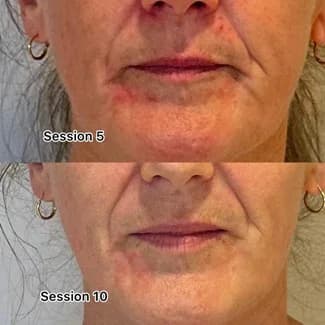
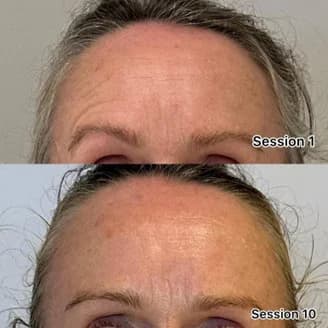
Changes in the client’s dermatitis in sessions 5 and 10. © Yumiko Inoue Changes in the client’s wrinkles, eyebrow symmetry. © Yumiko Inoue Note: Around session five, her dermatitis had worsened due to elevated stress levels. However, she gradually began learning how to manage her stress, and by the final session, we observed noticeable improvement in her skin condition. Furthermore, there was a noticeable reduction in forehead wrinkles and an improvement in eyebrow symmetry. Her skin texture showed significant improvement over the course of eight sessions, aligning with the approximately 28-day skin cell turnover cycle.
Results
Progressive improvements were noted in skin firmness, hydration, and luminosity. The client reported improved mood regulation, deeper sleep, and reduced anxiety. A strong scent-memory connection developed, with the facial oil acting as a sensory cue for relaxation between sessions.
Evaluation
The sessions offered more than a physical improvement from the client’s perspective; they became a space of reflection, support, and self-connection. She reported greater self-awareness and resilience in emotionally demanding situations, alongside noticeable changes in skin tone and comfort.
Conclusion
The combination of facial reflex therapy and a tailored facial oil blend proved effective in this case, addressing both visible skin concerns and underlying emotional tension. Over the course of ten sessions, the client experienced noticeable improvements in skin tone and texture, as well as facial muscle relaxation and overall emotional balance. This was supported by both practitioner observation and the client’s own feedback.
While this case offered insight into how a personalised combination of facial reflex therapy and aromatherapeutic skincare may support emotional and skin-related concerns during menopause, the findings are context-specific. This case reflects a single-client response, and the results may not be generalisable. Observations were largely subjective and practitioner-reported. While progress aligned with the treatment timeline, external factors, such as caregiving stress and personal habits, may have influenced outcomes. Structured outcome tools would provide additional insight into future studies.
Though anecdotal, this case suggests potential benefits of combining reflex-based facial massage with aromatic interventions for clients navigating hormonal and emotional transitions. Replicating the case with outcome measures or expanding it to a larger client group could strengthen these observations.
Acknowledgements
The authors are grateful to FC for her openness and commitment throughout this process and to Yumiko Inoue for her deep skill and compassionate presence during each session.
References
- Ali B N, Al-Wabel N A, Shams S, Ahamad A, Khan S A, Anwar F. (2015). Essential Oils Used in Aromatherapy: A Systematic Review. Asian Pacific Journal of Tropical Biomedicine. 5 (8), p601-611.
- Bomzon D. (2020). Clinical Handbook of Yamamoto New Scalp Acupuncture. London, UK: Singing Dragon.
- Buckle J. (2015). Clinical Aromatherapy: Essential Oils in Healthcare, 3rd ed. London, UK: Churchill Livingstone.
- Cassara P A and Carrasco A R. (2013). Dien Chan – Multireflexology. Apple Books.
- Crăciun L M, Dumitriu B G, Olariu L ... Papacocea R. (2019). Regenerative and Scar Healing Potential of Active Compounds from Camelina sativa Oil and Grape Pomace. Romanian Biotechn Let. 24 (6), p1075-1082.
- Dimitrijevic J, Tomovic M, Bradic J, Petrovic A, Jakovljevic V ... Dragicevic N. (2024). Punica granatum L. (Pomegranate) Extracts and Their Effects on Healthy and Diseased Skin. Pharmaceutics. 16 (4), p458.
- Ferreira R M, Flórez-Fernández N ... Domínguez H. (2024). Opuntia ficus-indica Seed Pomace Extracts with High UV-Screening Ability in a Circular Economy Approach for Body Lotions with Solar Protection. J of Cleaner Production. 262: 121421.
- Lamarão M L N, Ferreira L M M C, Lynch D G ... Ribeiro-Costa R M. (2023). Pentaclethra macroloba: A Review of the Biological, Pharmacological, Phytochemical, Cosmetic, Nutritional, and Biofuel Potential of this Amazonian Plant. Plants. 12 (6), p1330.
- Lin T K, Zhong L, Santiago J L. (2017). Anti-Inflammatory and Skin Barrier Repair Effects of Topical Application of Some Plant Oils. International Journal of Molecular Sciences. 19 (1), p70. doi.org/10.3390/ijms19010070
- Murthy H N, Yadav G G, Dewir Y H, Ibrahim A. (2020). Phytochemicals and Biological Activity of Desert Date (Balanites aegyptiaca (L.) Delile). Plants. 10 (1), p32. doi.org/10.3390/plants10010032
- Oargă D P, Cornea-Cipcigan M, Nemeș S A, Cordea M I. (2025). The Effectiveness of a Topical Rosehip Oil Treatment on Facial Skin Characteristics: A Pilot Study on Wrinkles, UV Spots Reduction, Erythema Mitigation, and Age-Related Signs. Cosmetics. 12 (3), p125.
- Parker S M. (2015). Power of the Seed: Your Guide to Oils for Health & Beauty. Port Townsend, WA: Process Media.
- Poljšak N and Kočevar Glavač N. (2022). Vegetable Butters and Oils as Therapeutically and Cosmetically Active Ingredients for Dermal Use: A Review of Clinical Studies. Frontiers in Pharmacology. 13: 868461.
- Price S, Price L, Price P. (2021). Aromatherapy for Health Professionals, 5th ed. London, UK: Elsevier.
- Schockert T. (2011). Yamamoto New Scalp Acupuncture (YNSA): Development, Principles, Safety, Effectiveness and Clinical Applications. IntechOpen. Available: https://www.intechopen.com/chapters/18907. Last accessed 6 September 2025.
- Sorensen L L. (2011a). Facial Reflexology. Uttar Pradesh, India: B. Jain Publishers Pvt. Ltd.
- Sorensen L L. (2011b). Sorensensistem Facial Reflexology. Basic 7 Steps, Acupuncture Point, Vascular Point, Nerve Ending, NP Points, N points, Cranial Lines and Points. World Massage Conference.
- Tietel Z, Melamed S ... Cohen G. (2024). Topical Application of Jojoba (Simmondsia chinensis L.) Wax Enhances the Synthesis of Pro-Collagen III and Hyaluronic Acid and Reduces Inflammation in the ex-vivo Human Skin Organ Culture Model. Front in Pharma. 15: 1333085.
- Truong T M L. (2018). Dien Chan – Vietnamese Facial Multi-Reflexology: Basic Practical Course Manual. You Can Print Publishing
Yasmine ElGhamrawy is a certified Aromatherapist, natural skincare formulator, and founder of the award-winning brand Yatlina®. Her work blends scientific insight with traditional plant-based care to create targeted Aromatherapy products and functional scent experiences. Through Yatlina® she offers clinical Aromatherapy, bespoke scent services, seasonal workshops, and aromatic travel programmes that explore the cultural roots and practical uses of essential oils. Yasmine’s proprietary blend “Immortal Beauty” was used in this case study. www.yatlina.com
Yumiko Inoue is an experienced complementary therapist with nearly 30+ years of expertise in wellness and beauty, with features in top lifestyle publications and a reputation for beautifully transformative work. Specialising in Aromatherapy, facial reflex therapy, Japanese cosmo lifting, foot reflexology, and manual lymphatic drainage, and face yoga. Her integrated and client-first approach supports both inner balance and outer radiance. She is also a hands-on teacher for Sorensensistem.