
Last year, in 2006, I had the opportunity to visit Morocco twice. Morocco is also well known for its rose water, which is used as a home remedy. In recent years, the country has produced 300 tonnes of essential oils, exporting them to Europe, the United States, and other countries. Arab medicine has long been practiced in Moroccan homes, utilizing as many as 340 aromatic plants. In this article, I'd like to introduce two oils that are gaining attention not only in Morocco but also here in the UK: argan oil and black cumin seed oil. Argan oil is likely a topic of discussion in Japan as well.
The properties of argan oil were first documented in 1219 by Ibn Al Baytar, a renowned Egyptian physician. However, it was actually introduced to the world in 1510 by the traveler Leo Africanus (1485-1554). Argan trees once grew in North Africa and southern Europe, and in 1771, specimens were brought to Badminton in Amsterdam and cultivated by Lady Beaufort. However, it is estimated that approximately 21 million argan trees survive today, covering approximately 860,000 hectares in southwestern Morocco, between Essaouira and Agadir. In 1999, the area was designated a UNESCO Biosphere Heritage Site.
Argan trees grow in dry, semi-desert areas. They go dormant during the dry season and regenerate when rain falls. They can survive temperatures as low as 50°C. Argan trees vary in size, from single-trunked to semi-twined and thick-trunked, growing up to 10 meters tall. They can live for 200 to 250 years, with most of their fruit produced after 50 to 60 years. In spring, argan trees bloom with small green-yellow flowers and bear round fruits, slightly larger than green olives, that turn yellow as they ripen (Photo 1). Each tree can produce approximately 8 kg of fruit. In summer, they dry out and turn black (Photo 2), and begin to fall to the ground, where they are collected by hand. These fruits are usually found on public land belonging to the Moroccan Forest Tree Commission. The right is given to families whose work has been passed down for generations, and they are only allowed to collect the fruit within a short distance of their residence. Three months before the harvest, animals are strictly prohibited from grazing on argan trees. The trees have sharp thorns that protect the fruit from manual picking. However, in the past, many goats were seen climbing the trees and devouring the fruit, leading to the area being called the "tree pasture." Recently, foresters have banned goats from grazing on the fruit, and owners who do not follow the rules are subject to fines.
The argan fruit contains one, two, or three almond-sized kernels encased in a very hard shell. Berber women crack each kernel by hand using two stones. It takes them 10 to 20 hours to extract enough kernels to produce one liter of argan oil. After the oil is extracted, the kernels are left with a sweet, chocolate-colored paste that's used with crushed almonds and honey to make "Amlou," a bread spread that's an essential part of Berber breakfasts. It's said to taste similar to peanut butter. The pulp is then fed to goats, and the oil is used to light lamps. The remaining seeds are then fed to livestock. The husks are also used to fuel ceramic bread ovens, providing a fire for about 30 minutes, ensuring no waste is wasted. Argan wood is also used to produce the inlaid boxes from Essaouira.
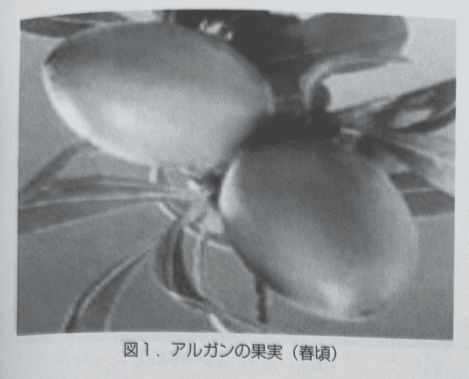
Figure 1. Argan fruit (around spring)
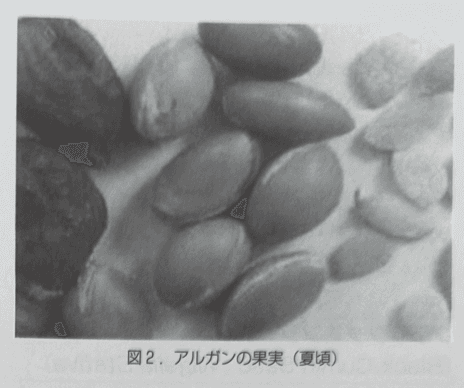
Figure 2. Argan fruit (around summer)
The Berber people lived in North Africa before the Arabs arrived and have a history and culture spanning over 4,000 years. The Berber region was known in ancient times as Mauritania and Numidia. Between the 11th and 13th centuries, two great Berber dynasties, the Almoravids and the Almohads, controlled most of Spain and northwestern Africa. Today, the majority of Berbers reside in Morocco and Algeria, with smaller populations in Tunisia, Libya, and Egypt. Berbers make up 40 percent of Morocco's population, and many others likely have Berber ancestry. They speak their own language, though it is not officially recognized.
The Peruvian people have used argan oil, rich in nutty aroma and a tangy taste, not only as a smear on bread but also in a wide range of home cooking, such as as a seasoning for couscous dishes and salads, and for women's hair, skin, and nail care. It has also traditionally been used to treat acne, dry eczema, psoriasis, chickenpox, all kinds of scars, prevent stretch marks, and treat joint and muscle pain, and is still used today as a home remedy.
Argan oil is available for both edible and skin care applications, and is also available in Japan. Argan oil contains twice the amount of vitamin E as olive oil, as well as antioxidants. Vitamin E and skin-softening saponins help combat the aging process, preventing wrinkles by restoring the skin's moisture-retaining lipid layer and calming and soothing skin inflammation. Antioxidants neutralize free radicals, protecting skin from wind and sun exposure during cold winters. Argan oil's 80% unsaturated fatty acids contain eight essential fatty acids that affect cellular fluidity, moisturizing the skin and supporting the lining of the nose, lungs, digestive system, and brain. It also reduces fluid stickiness, improves blood circulation, lowers cholesterol levels and blood pressure, and protects against heart attacks. Argan oil also contains 34-36% linoleic acid (omega-6), a fatty acid that the human body cannot produce. It also contains sterols, which are quite rare among vegetable oils, and promotes the formation of prostaglandins, reducing pain and swelling. This is said to be effective for treating symptoms of arthritis and rheumatism. However, it should not be used on injured or oozing skin.
Finally, according to the official website of Sunku Co., Ltd., the components of argan oil are listed as follows: oleic acid (approx. 43.8%), linoleic acid (approx. 37.2%), palmitic acid (approx. 12.4%), stearic acid (approx. 5.5%), linolenic acid (approx. 0.1%), and unsaponifiable matter (tocopherols, sterols, triterpenes, polyphenols) (approx. 1.0%).
Black cumin was famously found in Tutankhamun's tomb, demonstrating its importance to ancient Egyptian beliefs. The ancient Egyptians considered black seeds a panacea, and the Romans called them Greek coriander. Black cumin seeds are mentioned in the Book of Isaiah, part of the Old Testament. According to Easton's Bible Dictionary, ketsah, the Hebrew word for black cumin, is a wild plant in the Ranunculaceae family. It was recorded by a first-century Greek physician as being used to treat headaches, nasal congestion, toothaches, and intestinal parasites. He also described its use as a diuretic, to stimulate menstruation, and to aid in breast milk production. Furthermore, approximately 1,400 years ago, in the Prophetic Medicine, Prophet Mohammad mentioned in a hadith that black seed oil was effective in treating all illnesses except fatal diseases. The Islamic scholar Albiruni (973-1048) published a treatise on the origins of Indian and Chinese medicine, in which he also mentioned black seed, citing it as a grain called alwanak in Sigzi. Later, Suhar Bakht documented the nutritional use of Sigzi grains (Habb-I-Sajzi) in the 10th and 11th centuries. In the Greco-Arabic medical science discovered by Hippocrates, black seed was recognized by contemporary physicians and Ibn Sina (980-1037) as an important medicine for liver and digestive disorders. Ibn Sina's famous text on Eastern and Western medicine, "The Canon of Medicine," mentions black seed as a potent energy booster and effective in relieving fatigue and depression. Recent academic research has shown that most illnesses are caused by immune system imbalances or dysfunction, and it is now widely accepted that black seed has the ability to boost the immune system.
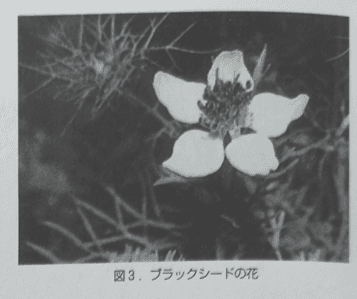
Figure 3. Black seed flower
Black seed is an annual herb originally native to the Mediterranean region but now cultivated in the Arabian Peninsula, North Africa, Australia, and parts of Asia. It is important to note that it is different from cumin, an herb commonly used in cooking. Black seed is very small and hairy, less than 3 mm long. It is a member of the Nigella sativa (Ranunculaceae) family, but is often confused with herb fennel. The lower leaves are small and stalked, while the upper leaves grow long, reaching about 6-10 cm in length. They produce white flowers with a bluish-purple interior (Photo 3). By the time the fruit matures, it grows to about 30-46 cm in height. When the ripe fruit capsule opens, the white seeds inside are exposed to air and gradually turn black. Black seed is often called by different names depending on the region.
Since 1959, more than 200 international university studies on black cumin seed oil have been published in academic journals. In 1986, Munich immunologist Dr. Peter Schleicher furthered his research on the oil, documenting its anti-inflammatory prostaglandin E1 activity, which has broad applications in treating acne, hay fever, various inflammatory and fungal infections, and even cancer. Subsequently, Professor G. Rietmuller of the University of Munich focused on the potential bioregulatory potential of this oil, which has an effect on the immune system. Furthermore, dermatologist Professor Michael Meurer, based on his many years of experience, has confirmed its anti-inflammatory properties and is convinced that it also has beneficial effects on the nervous system. At the recent International Council for Cancer Research Conference in New Delhi, black cumin seed oil was introduced to numerous scientists and physicians for its anti-tumor properties. Furthermore, its effects on bone marrow and immune cells have garnered attention, potentially helping to treat cancer, AIDS, and other immune-compromised conditions. Traditionally used for centuries in the Middle and Far East, black seeds are used both internally and externally to treat asthma, bronchitis, colds, influenza, catarrh, jaundice, rheumatism and related inflammation, digestive disorders, kidney and liver function, diuretic properties, immune system enhancement, and breast milk production. Black seed oil is also used to treat skin conditions such as eczema, furuncles, boils, and psoriasis, and for scalp massage.
Black cumin seed oil is rich in unsaturated acids and essential fatty acids, especially linoleic acid, and contains trace amounts of linolenic acid, which help boost the immune system and suppress allergic reactions. It comprises approximately 50% essential fatty acids, 30% oil, and 20% protein and carbohydrates. Of this, 1.4% is essential oil, consisting of 46.8% baracymene, 21.1% carvone, 7.7% beta-vinene, 7.4% alpha-vinene, 5.5% sabinene, and 11.5% other essential oils. Nigerone and thymosinone, which make up 1.5-5% of the volatile oils, have antihistamine, anti-infective, and bronchodilator properties. Black cumin seed oil is also known for its high nutritional value.
Colds are extremely prevalent this time of year, and I hear stories here and there of people coughing for weeks without stopping, followed by vomiting. Even in my household, I regularly use homeopathic remedies, but once the coughing started, it wouldn't stop. Since I started taking black cumin seed oil, my symptoms have improved significantly. An acquaintance actually introduced me to this oil last year, and I never realized how useful it would be. I'm so grateful for it. It seems that black cumin seed oil isn't readily available in every pharmacy here in the UK, but it does appear to be available. Of course, both black cumin seed oil and argan oil are readily available in Morocco, but not all stores stock pure oils, and there are many people selling adulterated oils as genuine, so caution is advised. Finally, both can be taken internally as well as externally, and both have the advantage of being incorporated into your daily diet rather than just as medicine.
Yumiko Inoue

After graduating from Otsuma Women's University in March 1998 with an associated degree in English Literature, she worked for major companies in Tokyo and London. In the summer of 1997, she moved to the UK and obtained qualifications in Aromatherapy from the Tisserand Institute and in Reflexology from the Bailey School. She also obtained qualifications in Advanced Aromatherapy, Indian Champissage, Reiki, Lymphatic Drainage, Hydrotherapy and VibroTone. She also studied Body Psychotherapy at the Chiron Center. She has gained experience at a major spa, a hospice, and as a teaching assistant. Currently, while a mother of one, she practices therapy at Balance the Clinic in Chelsea, London.